
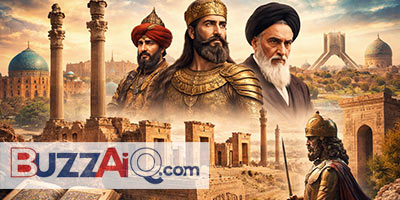
Iran and Its History: A Complete Guide to Persian Civilization, Empires, Revolution, and Modern Identity
Table of Contents (TOC)
- Introduction
- Where Iran Fits in World History
- Ancient Iran and the Rise of Persian Civilization
- The Achaemenid Empire: The First Great Persian Empire
- Parthian and Sasanian Iran
- The Islamic Conquest and the Transformation of Iran
- The Safavid Dynasty and the Shaping of Modern Iran
- Qajar Iran, Foreign Pressure, and Constitutional Change
- The Pahlavi Era and State Modernization
- The 1979 Iranian Revolution
- Iran in the Modern Era
- Key Takeaways
- FAQ
- Conclusion
Introduction
Iran and its history is one of the richest and most influential stories in the world. From the grandeur of the Persian Empire to the Islamic Revolution and the formation of the modern Iranian state, Iran has shaped politics, religion, culture, language, trade, and intellectual life across Asia, the Middle East, and beyond. Historically known as Persia in the West, Iran stands at the crossroads of ancient civilization and modern geopolitics, making its past both fascinating and essential to understand. Its story includes imperial power, cultural continuity, religious transformation, foreign intervention, and national resilience.
1. Where Iran Fits in World History
Iran is located in southwestern Asia and has long held strategic importance because of its geography, resources, and position between Central Asia, South Asia, the Caucasus, and the Middle East. For centuries, the Iranian plateau served as a bridge between civilizations. This helped Iran become not just a kingdom or a nation, but a major civilizational center whose influence spread through empire, trade routes, literature, religion, and administration.
What makes Iran unique in world history is continuity. Although dynasties changed, religions shifted, and foreign invasions occurred, Iranian identity endured. Persian language, court culture, artistic traditions, and administrative practices repeatedly survived and adapted.
2. Ancient Iran and the Rise of Persian Civilization
The roots of Iranian civilization stretch back to early Indo-Iranian migrations and the emergence of societies across the Iranian plateau. Over time, groups such as the Medes and Persians rose in political importance. Ancient Iran became a center of organized statecraft, military power, and religious development, including the rise of Zoroastrian ideas that influenced later spiritual traditions in the region.
Why ancient Iran matters
- It produced one of the earliest large-scale imperial systems
- It connected East and West through trade and governance
- It developed durable traditions in kingship, law, architecture, and religion
These foundations prepared the way for the first great Persian imperial age.
3. The Achaemenid Empire: The First Great Persian Empire
When people think of the glory of Persia, they often begin with the Achaemenid Empire. Founded in the 6th century BCE by Cyrus the Great, this empire expanded rapidly and became one of the largest empires of the ancient world. It ruled a vast territory stretching across parts of Asia, the Middle East, North Africa, and Europe.
Cyrus is widely remembered for military achievement and statecraft. Under Achaemenid rule, imperial administration became more sophisticated, with provinces governed through satrapies, road systems improved for communication, and local customs often accommodated under imperial authority. This pragmatic style helped Persia manage immense diversity.
Key features of Achaemenid rule
- Centralized but flexible administration
- Large-scale road and communication networks
- Monumental capitals such as Persepolis
- A legacy of imperial governance studied to this day
The empire eventually fell to Alexander the Great in the 4th century BCE, but Persian political culture did not disappear.
4. Parthian and Sasanian Iran
After Alexander and the Seleucid period, Iranian power revived under the Parthians, who became known for resisting Roman expansion and maintaining a durable empire for centuries. The Parthians preserved Iranian political traditions while engaging with Hellenistic and regional influences.
They were followed by the Sasanian Empire, one of the most important pre-Islamic Iranian states. The Sasanians strengthened central authority, promoted Persian court culture, and elevated Zoroastrianism as a major state religion. Their rivalry with the Byzantine Empire shaped late antique history and set the stage for the transformations that would follow in the 7th century.
5. The Islamic Conquest and the Transformation of Iran
A major turning point in Iran and its history came with the Arab conquest in the 7th century CE. This period brought Islam to Iran and gradually reshaped political, religious, and cultural life. Yet the transformation was not simply a replacement of one civilization by another. Instead, Iran absorbed Islam while also deeply influencing Islamic civilization in return.
Persian language and literary culture re-emerged strongly in the Islamic period. Over time, Iran contributed immensely to philosophy, science, poetry, theology, art, and statecraft across the broader Islamic world. Figures in Persian literary tradition and court culture helped preserve a distinctly Iranian identity even after the fall of pre-Islamic empires.
A major historical insight
Iran became Islamized, but not culturally erased.
Instead, it became one of the central engines of Islamic civilization.
6. The Safavid Dynasty and the Shaping of Modern Iran
The Safavid dynasty (1501–1736) was one of the most decisive periods in Iranian history. The Safavids established Twelver Shi?ism as the state religion, a development that played a major role in shaping Iran’s modern religious and national identity. This period is often seen as the foundation of the Iranian state in a form closer to what later became modern Iran.
The Safavids also consolidated territory, strengthened monarchy, promoted architecture and art, and turned cities such as Isfahan into major cultural centers. Their state helped unify diverse ethnic and linguistic communities under a more coherent political and religious framework.
Why the Safavid era is so important
- It helped define Iran as a distinct Shi?i state
- It strengthened a unified political identity
- It left a lasting legacy in architecture, art, and governance
7. Qajar Iran, Foreign Pressure, and Constitutional Change
The Qajar dynasty ruled from the late 18th century into the early 20th century. This era was marked by internal weakness, economic strain, and growing foreign pressure from Russia and Britain. Iran’s strategic importance made it a target of outside influence, and many Iranians grew dissatisfied with corruption, concessions to foreign powers, and weak governance.
These tensions contributed to the Constitutional Revolution of the early 20th century, a landmark movement that sought legal reform, representative government, and limits on royal power. The creation of a parliament, or Majles, became one of the most important political developments in modern Iranian history.
8. The Pahlavi Era and State Modernization
The Pahlavi dynasty, beginning with Reza Shah in 1925, launched major modernization projects in Iran. State institutions were strengthened, infrastructure expanded, legal reforms advanced, and the monarchy pushed a more centralized nationalist vision. Later, under Mohammad Reza Shah, modernization deepened through industrialization, education, and state-led reform.
However, modernization also brought tension. Many critics objected to authoritarian rule, political repression, uneven development, dependence on foreign powers, and cultural policies seen as too top-down. These tensions intensified in the later 20th century and eventually fed revolutionary change.
Pros and Cons of the Pahlavi period
Pros
- Rapid state modernization
- Expansion of infrastructure and institutions
- Greater central administrative control
Cons
- Political repression
- Social inequality and uneven reform outcomes
- Deep resentment over foreign influence and monarchy-centered rule
9. The 1979 Iranian Revolution
The Iranian Revolution of 1979 transformed the country. Massive dissatisfaction with the monarchy, combined with religious leadership, political activism, and social unrest, led to the overthrow of the Shah. Soon after, Iran was officially declared an Islamic Republic in 1979 following a national referendum.
This revolution was one of the most important political events of the 20th century in the Middle East. It reshaped the Iranian state, redefined its political ideology, and altered Iran’s relationship with the West and the wider region.
10. Iran in the Modern Era
Modern Iran combines deep historical continuity with intense political complexity. It is a country whose present cannot be understood without its long past: imperial memory, religious identity, constitutional struggle, modernization, revolution, and geopolitical rivalry all remain relevant. The country continues to matter globally because of its population, strategic location, energy resources, political influence, and civilizational legacy.
For readers trying to understand Iran today, the key is not to reduce it to a single era or political event. Iran is at once ancient and modern, Persian and Islamic, national and regional, literary and political. Its history is layered, and that complexity is exactly what makes it so significant.
11. Key Takeaways
- Iran is one of the world’s oldest continuous civilizations.
- Ancient Persia created one of history’s greatest empires.
- Islamic conquest transformed Iran, but Persian identity remained strong.
- The Safavid period was crucial in shaping Iran’s Shi?i identity.
- The Qajar and Pahlavi eras brought reform, foreign pressure, and modernization.
- The 1979 revolution created the modern Islamic Republic.
FAQ
1. Why was Iran previously called Persia?
“Persia” was the name long used in the West, mainly derived from the region of Pars or Fars. “Iran” became the country’s official international name in the 20th century, though both terms still appear in historical and cultural discussion.
2. What is the most important empire in Iranian history?
Many historians highlight the Achaemenid Empire because it was one of the largest and most influential empires of the ancient world. However, the Safavid Empire is also crucial because it helped shape Iran’s modern religious and national identity.
3. How did Islam change Iran?
Islam changed Iran politically and religiously after the Arab conquest, but Persian language, literature, and culture remained influential. Over time, Iran became a major center of Islamic civilization while preserving a distinct identity.
4. Why is the Safavid dynasty so important in the history of Iran?
The Safavids established Twelver Shi?ism as the state religion and helped unify Iran under a more coherent political and religious structure, making their rule a turning point in Iranian history.
5. What happened in the Iranian Revolution of 1979?
The revolution overthrew the monarchy of Mohammad Reza Shah and led to the establishment of the Islamic Republic of Iran in 1979. It remains one of the most consequential events in modern Middle Eastern history.
6. Why is Iran important today?
Iran remains important because of its strategic geographic position, historical influence, large population, natural resources, and major role in regional politics and global diplomacy.
Conclusion
Understanding Iran and its history means looking far beyond headlines. Iran is the heir to ancient empires, a major center of Persian civilization, a powerful contributor to Islamic intellectual life, and a modern state shaped by revolution, reform, and resilience. Its story is not simple, but that is exactly why it matters. For anyone interested in world history, Middle Eastern politics, religion, or culture, Iran is impossible to ignore.

BuzzAiQ online library offers a vast collection of literature and resources for easy access and exploration.